


Page 35 - The South China Business Journal
P. 35
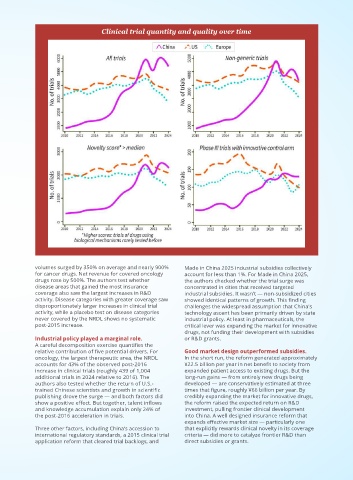
Clinical trial quantity and quality over time


             volumes surged by 350% on average and nearly 900%   Made in China 2025 industrial subsidies collectively
             for cancer drugs. Net revenue for covered oncology   account for less than 1%. For Made in China 2025,
             drugs rose by 500%. The authors test whether      the authors checked whether the trial surge was
             disease areas that gained the most insurance      concentrated in cities that received targeted
             coverage also saw the largest increases in R&D    industrial subsidies. It wasn't ? non-subsidized cities
             activity. Disease categories with greater coverage saw   showed identical patterns of growth. This finding
             disproportionately larger increases in clinical trial   challenges the widespread assumption that China's
             activity, while a placebo test on disease categories   technology ascent has been primarily driven by state
             never covered by the NRDL shows no systematic     industrial policy. At least in pharmaceuticals, the
             post-2015 increase.                               critical lever was expanding the market for innovative
                                                               drugs, not funding their development with subsidies
             Industrial policy played a marginal role.         or R&D grants.
             A careful decomposition exercise quantifies the
             relative contribution of five potential drivers. For   Good market design outperformed subsidies.
             oncology, the largest therapeutic area, the NRDL   In the short run, the reform generated approximately
             accounts for 43% of the observed post-2016        ?22.5 billion per year in net benefit to society from
             increase in clinical trials (roughly 439 of 1,004   expanded patient access to existing drugs. But the
             additional trials in 2024 relative to 2016). The   long-run gains ? from entirely new drugs being
             authors also tested whether the return of U.S.-   developed ? are conservatively estimated at three
             trained Chinese scientists and growth in scientific   times that figure, roughly ?66 billion per year. By
             publishing drove the surge ? and both factors did   credibly expanding the market for innovative drugs,
             show a positive effect. But together, talent inflows   the reform raised the expected return on R&D
             and knowledge accumulation explain only 24% of    investment, pulling frontier clinical development
             the post-2016 acceleration in trials.             into China. A well designed insurance reform that
                                                               expands effective market size ? particularly one
             Three other factors, including China's accession to   that explicitly rewards clinical novelty in its coverage
             international regulatory standards, a 2015 clinical trial   criteria ? did more to catalyze frontier R&D than
             application reform that cleared trial backlogs, and   direct subsidies or grants.

